How Often to Change Cat Litter
There is no single magic number, and anyone who gives you one is guessing. The right gap depends on what is in the box, how many cats use it, and whether the smell comes back before the litter looks dirty.
Disclosure: Purrify is our product, and we may benefit if you buy it. Details
Three Jobs, Three Different Clocks
Most confusion about litter schedules comes from treating scooping, topping up, and changing as one task. They run on separate timers, and only one of them actually resets the box.
Scoop
Every day, ideally twice
Lifting out clumps and solids is the only part of the routine that removes the odor source. Skip a day and the smell you get back is not proportional to the day you saved.
Top up
Whenever depth drops
Scooping takes litter out with the clump. Once the bed falls under about three inches, urine reaches the bottom and soaks the plastic instead of forming a clump you can lift.
Full change
Type and traffic decide
Everything out, box washed, box dried, fresh litter in. This is the reset that removes the residue scooping leaves behind, and it is the one people stretch the longest.
Schedule by Litter Type
What is in the box changes the answer more than anything else. Clumping litter lets you remove urine. Every other type asks you to replace it instead.
Clay clumping
- Scoop
- Once or twice daily
- Full change
- Every 2 to 4 weeks for one cat
The most forgiving schedule, because urine leaves in one piece. Firm clumps are what buy you the long gap. If clumps break apart when you lift them, you are leaving wet crumbs behind and the box will need a full change closer to every two weeks.
Non-clumping clay
- Scoop
- Solids out daily, stir the bed
- Full change
- Every 3 to 5 days
Urine spreads through the whole bed and stays there. Nothing to lift out means nothing to remove, so the litter itself is the thing you replace. Stretching this one is the single most common reason a house smells like ammonia.
Crystal or silica
- Scoop
- Solids out daily, stir every day or two
- Full change
- Follow the bag, usually monthly for one cat
Crystals hold urine until they are saturated, and stirring spreads the load so one patch does not flood. When the crystals stop drying out between visits or the box smells the morning after a stir, it is done, whatever the calendar says.
Pine, wheat, corn, paper
- Scoop
- Daily, and sift the sawdust out
- Full change
- Every 1 to 2 weeks
Plant-based litters break down as they work, so the bed turns to fine sawdust at the bottom. Sift that out when you scoop. These run on a shorter clock than clay, and they get shorter in a humid room.
Not sure which type suits your household? Compare the tradeoffs in the best cat litter for odor control guide.
Schedule by How Many Cats
Two cats do not double the load on one box, they more than double it, because the box never gets a quiet stretch to dry out between visits. Adding a box is usually cheaper than upgrading everything else.
One cat, one box
Scoop daily. Top up weekly. Full change every two to four weeks with clumping litter. Most single-cat homes that smell are not on the wrong schedule, they are on the right schedule with two inches of litter in the box.
One cat, two boxes
The easiest home to keep fresh. Traffic splits, so each box loads at half the rate and you can run the far end of every range above. Still scoop both daily. A quiet spare box gets forgotten fast.
Two cats
Three boxes is the standard advice, one per cat plus a spare. Scoop morning and evening. Full change every one to two weeks. If one box does most of the work, that box comes out of rotation on its own faster clock.
Three or more cats
Assume weekly full changes and twice-daily scooping, then adjust down only if the boxes stay neutral. This is the household where an extra box does more for the smell than any product on the shelf.
Kittens
Small bladders, frequent visits, and litter that gets tracked and played with. Scoop more than once a day and change more often than the litter bag suggests. Keep the bed shallower so a kitten can get in and out.
Older or unwell cats
Cats who drink more, urinate more, or move less will fill a box faster and may need it closer to where they sleep. A sudden change in how much your cat urinates is a reason to call the vet, not a reason to buy stronger litter.
Sharing a home with several cats? The multi-cat odor control guide goes deeper on box placement and load.
Top Up or Fully Change?
Topping up replaces lost depth. It does not remove old residue. If the box smells clean right after scooping, topping up keeps clumps from hitting plastic and buys you time. If the box still smells after scooping, adding fresh litter is like putting clean sheets on a wet mattress. Empty it, wash it, dry it, refill it.
Top up when
- Clumps are still firm and lift out whole.
- The box smells neutral after scooping.
- Litter depth has dropped below three inches.
- The last full change was recent and the box is clean.
Fully change when
- The plastic smells once the litter is out.
- Clumps crumble and leave wet bits behind.
- Your cat hesitates, scratches outside, or avoids the box.
- Anyone in the house is holding their breath to walk past it.
Pair the schedule with the seven quick fixes for litter box smell and a monthly deep clean routine.
Signs the Box Is Overdue
Your nose is a better instrument than the calendar. Any one of these means the box needs a full reset now, not on schedule.
The room smells before you get near the box.
The box smells right after you scoop it, not just before.
Clumps crumble on the scoop and leave wet pieces behind.
The empty box still smells once all the litter is out.
Litter looks grey, damp, or packed rather than loose.
A ring of hardened litter is stuck to the bottom or the corners.
Your cat stands with a paw on the rim, or perches instead of digging.
Someone in the house has started using a scented candle near the box.
Depth Decides How Long the Schedule Holds
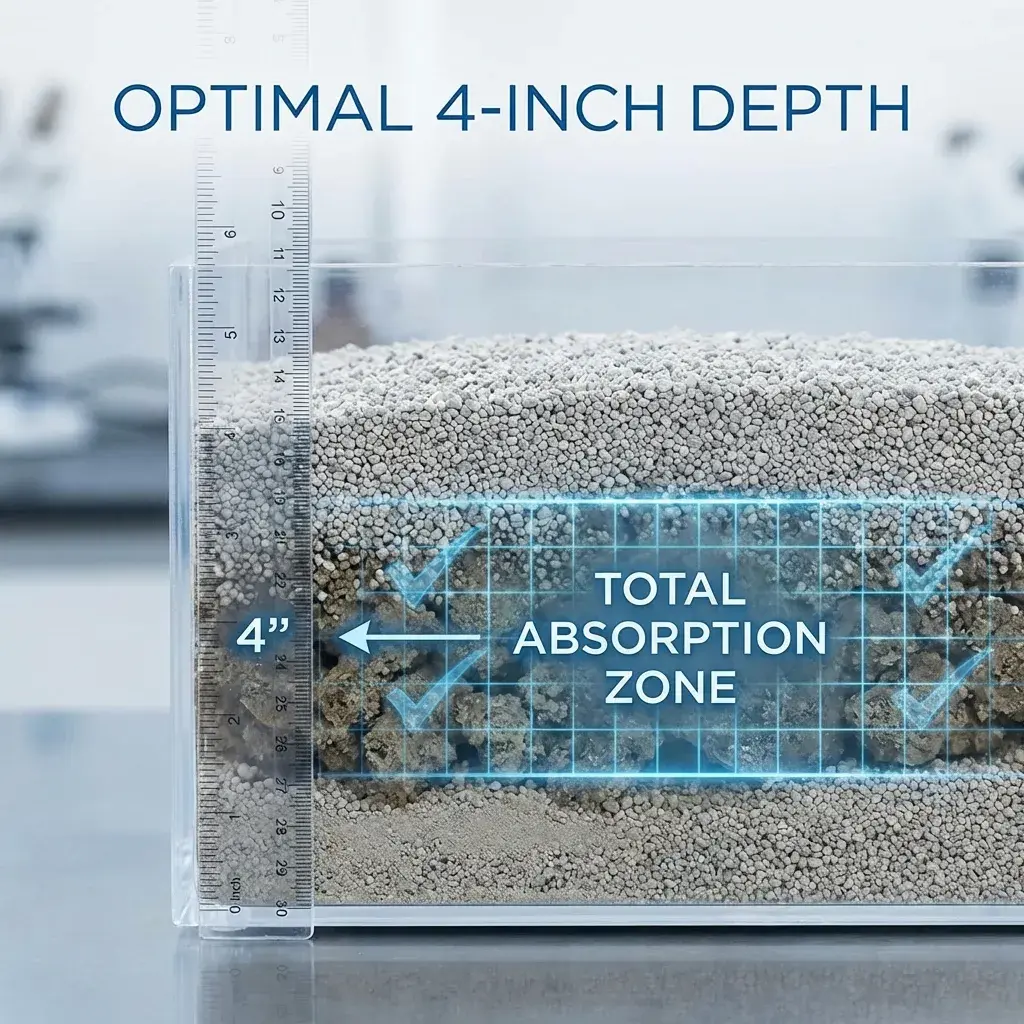
Three to four inches is the range worth defending. Below that, urine reaches the bottom before the litter can wrap it, so you get a wet patch stuck to the plastic instead of a clump on your scoop. That patch is what you smell two days later.
Every scoop removes litter along with the clump, so a box set up perfectly on Sunday is thin by Thursday. Keep the bag near the box and add a cup or two as you go. It takes ten seconds and it is the difference between a four-week box and a ten-day one.
The Full Change, Step by Step
Twenty minutes, start to finish, and most of that is drying time. Do it the same way every time and the box stops being a thing you dread.
- 1
Take the box outside or to a tub
Do this somewhere you can rinse and where the dust is not settling on your kitchen counter. Open a window in the room the box normally lives in while you work.
- 2
Empty everything, including the corners
Old litter goes in a bag that gets tied and taken out, not in a bin that sits under the sink until Thursday. Scrape the bottom crust with the flat edge of the scoop before you add water.
- 3
Wash with hot water and unscented dish soap
Soap and friction do the job. Skip bleach and ammonia-based cleaners: bleach with urine residue is a bad mix, and ammonia cleaners leave behind a smell that reads to your cat as another cat marking.
- 4
Check the plastic while it is clean and wet
Run a thumb across the bottom. Scratches hold urine no washing will reach. A box that still smells sour after a proper wash has reached the end of its life, and no schedule fixes that.
- 5
Dry it completely
Fresh litter poured into a damp box clumps to the bottom immediately, and you lose the whole point of the reset. Towel it, then let it sit in the air for a few minutes.
- 6
Refill three to four inches deep
Deep enough that urine forms a clump in the litter instead of on the plastic. Deep enough for a cat to dig and cover. Shallow litter is the quiet reason most schedules fail.
- 7
Put it back and note the date
A note on your phone beats guessing. Two weeks in, you will not remember whether the last full change was a Sunday or the Sunday before.
For the longer version, including what to do about a box that has gone sour, read the deep clean litter box guide.
What Shortens the Clock
Same litter, same cat, shorter gap. These four conditions are why your schedule works in one apartment and fails in the next.
Heat and humidity
Warm, damp air speeds up the bacteria that turn urine into ammonia. The same box on the same schedule smells worse in August than in February.
A hood with no airflow
A covered box holds the smell in until you open it, which makes it easy to run past the point you would otherwise have noticed.
A box in a closet
No air movement means odor pools and stays. Placement will not fix a dirty box, but a good spot buys real time on a clean one.
A box that is too small
A cramped box concentrates everything in one area and gets used unevenly. Bigger boxes spread the load and take longer to reach the tipping point.
If the smell is sharp and chemical rather than simply dirty, the ammonia smell guide covers what is going on. If a hood is part of your setup, see covered vs uncovered boxes.
Where Purrify Fits in the Schedule
Nothing you add to a box replaces emptying it. Purrify is activated carbon, sold in bags, and it works on the odor that escapes between scoops once your routine is already steady. Fix the depth, fix the scooping, then add carbon if the room still holds a smell.
If you are using it to stretch a full change from two weeks to six, you are using it to hide a problem rather than solve one, and your cat notices the box long before you do.
See Carbon Support for Box OdorFAQ
How often should you change cat litter?
Scoop every box at least once a day. With clumping clay litter and one cat, empty and wash the box every two to four weeks. Non-clumping clay needs a full change every three to five days, plant-based litter every one to two weeks, and crystal litter roughly monthly per cat. Multi-cat homes run at the fast end of every range.
How often should I change the litter with two cats?
Scoop morning and evening, and do a full change every one to two weeks with clumping litter. Three boxes for two cats spreads the load and lets each box last longer between resets.
Is it enough to just scoop and never change the litter?
No. Scooping removes clumps but leaves residue on the plastic and fine dust through the bed. Over time that residue is what you smell right after scooping, which is the signal the box needs to be emptied and washed.
Can I change cat litter too often?
You can waste litter, and some cats dislike a box that never smells like them at all. Changing weekly instead of monthly is not harmful, just more expensive. Changing the brand or texture too often is the bigger risk, because that is what makes cats stop using the box.
Why does the box smell the day after a full change?
Usually depth, drying, or the box itself. Too little litter lets urine reach plastic on the first visit, a damp box makes clumps stick to the bottom, and a scratched box holds odor that no wash removes.
How often should I replace the litter box itself?
When the plastic is visibly scratched or still smells after a proper wash and full drying. Scratches trap urine below the surface, and once that starts, cleaning stops working.
If Odor Returns Within a Day
A box that smells 24 hours after a full change is telling you something other than "change me more often". Check depth first, then box count, then the plastic itself. After that, work through why litter boxes smell in the first place. And if the smell is strong enough to sting, the health risks explainer is worth five minutes.